
.svg)
Why study in USA?
The United States is the world’s leading study destination, home to the highest number of globally ranked universities and a diverse range of academic programs known for academic flexibility, cutting-edge research, and strong industry integration.




Key Highlights
Wide Range of Institutions
Ivy League, liberal arts colleges, state universities, and community colleges.
Globally Recognised Degrees
Largest number of universities ranked among the world’s top institutions.
Flexible Education System
Credit-based system, allowing flexibility in course selection, majors, and interdisciplinary study.
Scholarships Opportunities
Wide availability of merit-based scholarships, assistantships, and financial aid.
OPT (Optional Practical Training)
Up to 12 months, and up to 36 months for STEM graduates.
Strong Career Pathways
Close ties with global industries, research labs, startups, and multinational companies.

Quick Facts

Capital
Washington, D.C.

Currency
United States Dollar (USD)

Language of Instruction
English

Intakes
Fall (August/September), Spring (January), Summer (limited)

Work Rights
On-campus up to 20 hours per week during study; off-campus via CPT/OPT

Popular states
California, New York, Texas, Massachusetts, Illinois
Application Checklist & Process
- Academic counselling and course selection
- University shortlisting and academic documents submission
- Statement of Purpose (SOP) and offer application
- Standardised tests (SAT/ACT/GRE/GMAT, if required)
- Offer acceptance and Form I-20 issuance
- SEVIS fee payment and visa interview preparation
- Visa application and interview preparation
- Pre-departure briefing and travel guidance
Education Framework in the USA
.svg)
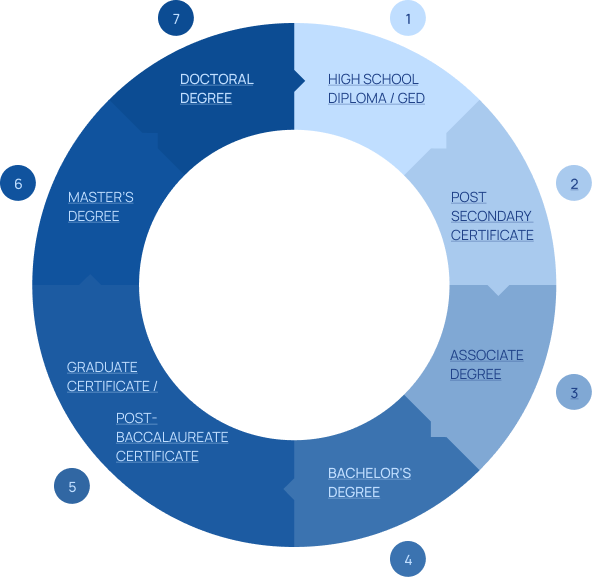
The USA has no single national framework. The education system operates on a credit-hour and GPA-based framework, offering flexibility and choice.
Key study levels include:
- Doctoral Degree
- Master’s Degree
- Bachelor's Degree
US universities are known for research excellence, innovation, and experiential learning.
Student Visa (Subclass 500): Key Points
- Form I-20 issued by a SEVP-approved US institution
- Proof of financial capacity
- Strong academic background and genuine study intent
- English language proficiency
- Visa interview at the US Embassy
Country map
To view the map, switch to the desktop view.
Universities
Ivy League Universities

Brown University
Columbia University
Cornell University
Dartmouth College
Harvard University
University of Pennsylvania
Princeton University
Yale University
A group of elite private universities known for exceptional academic standards, historic prestige, and highly selective admissions. Ivy League institutions offer world-class education, influential alumni networks, and outstanding global recognition.
Top Research Universities
Stanford University
Massachusetts Institute of Technology
California Institute of Technology
University of Chicago
Duke University
Johns Hopkins University
Northwestern University
New York University
University of California, Berkeley
University of California, Los Angeles
University of Michigan
University of Texas at Austin
University of Illinois Urbana-Champaign
University of Washington
Georgia Institute of Technology
Globally ranked universities recognised for cutting-edge research, innovation, and excellence in STEM, business, and interdisciplinary fields. These institutions offer strong academic rigor, industry partnerships, and excellent career outcomes.
Public Universities
Arizona State University
University of California, San Diego
University of California, Davis
University of Florida
Florida State University
University of Wisconsin, Madison
Ohio State University
Pennsylvania State University
Michigan State University
Purdue University
University of Minnesota, Twin Cities
University of Maryland, College Park
University of North Carolina, Chapel Hill
University of Colorado Boulder
University of Arizona
Large, state-funded universities offering high-quality education at relatively affordable tuition fees. Known for diverse programs, strong research output, and excellent career opportunities for international students.
Private & Liberal Arts Colleges
Amherst College
Williams College
Pomona College
Swarthmore College
Haverford College
Bowdoin College
Middlebury College
Colby College
Bates College
Lafayette College
Oberlin College
Macalester College
Teaching-focused institutions with small class sizes and a strong emphasis on undergraduate education. These colleges prioritise critical thinking, close faculty interaction, and holistic learning experiences.
Frequently Asked Questions
What are the most popular courses to study in the USA?
Popular and in-demand programs among international and Nepali students include STEM programs, Business, Finance.
What is the cost of studying in the USA?
- Tuition fees vary widely by institution and program:
- Bachelor’s programs: USD 20,000 – 45,000 per year
- Master’s programs: USD 25,000 – 55,000 per year
- Community colleges and public universities may offer more affordable options.
Are scholarships available for Nepali students?
Yes. US universities offer merit-based scholarships, need-based financial aid, and graduate assistantships for eligible students.
What is the cost of living in the USA?
- Average Monthly Cost: USD 1,800 – 3,000
- Breakdown:
- Accommodation: USD 900 – 1,800
- Food: USD 300 – 600
- Transport: USD 80 – 150
- Health insurance: USD 100 – 300
- Personal expenses: USD 200 – 400
- Annual Estimate: USD 22,000 – 36,000
- Costs vary significantly by state and city.
How much GPA is required to study in the USA from Nepal?
- Academic requirements vary by institution:
- Bachelor’s programs: 2.7 – 3.0 GPA (or equivalent)
- Master’s programs: 2.8 – 3.2 GPA or higher
- Lower GPAs may be considered with strong profiles, work experience, or test scores.
Can Nepali students work while studying in the USA?
- Yes. Students can work on-campus up to 20 hours per week during study. Off-campus work is allowed through CPT (during study) and OPT (after graduation).
Can I stay in the USA after graduation?
Eligible graduates can apply for OPT, allowing 12 months of work for most programs and up to 36 months for STEM-designated programs
Lorem Ipsum is simply dummy text of the printing
Lorem Ipsum is simply dummy text of the printing
Book a Session