Why study in UK?
With over 100 universities, including the prestigious Russell Group, students benefit from world-class teaching, cutting-edge research, and globally recognized degrees




Key Highlights
Globally Recognized Degrees
Multiple universities consistently ranked among the world’s top institutions.
Shorter Course Duration
3-year bachelor’s and 1-year master’s programs.
Post-Study Opportunities
Graduate Route Visa allows 2 years of post-study stay (3 years for PhD graduates).
Scholarships
Prestigious awards such as Chevening, Commonwealth, and GREAT Scholarships.
Strong Career Pathways
Strong industry links, internships, and global employability across industries

Quick Facts

Capital
London

Currency
British Pound Sterling (GBP)

Language of Instruction
English

Intakes
January, May (limited), September

Work Rights
Up to 20 hours per week during study, full-time during breaks

Popular Cities
London, Manchester, Birmingham, Leeds, Nottingham, Coventry
Application Checklist & Process
- Academic counselling and course selection
- University shortlisting and academic documents submission
- Statement of Purpose (SOP) and offer application
- Offer acceptance and Confirmation of Acceptance for Studies (CAS)
- No Objection Letter (NOC) from the Ministry of Education
- Financial documentation preparation
- Visa application and biometric appointment
- Pre-departure briefing and travel guidance
Student Visa (Subclass 500): Key Points
- Confirmation of Acceptance for Studies (CAS) from a UK institution
- Proof of financial capacity (tuition + living costs)
- English language proficiency (IELTS / UKVI IELTS or equivalent)
- Immigration Health Surcharge (IHS) payment
- Academic progression and credibility assessment
Country map
To view the map, switch to the desktop view.
Universities
Russell Group

University of Birmingham
University of Bristol
University of Cambridge
Cardiff University
Durham University
University of Edinburgh
University of Exeter
University of Glasgow
Imperial College London
King’s College London
London School of Economics and Political Science (LSE
University of Manchester
Newcastle University
University of Nottingham
Queen’s University Belfast
University of Sheffield
University of Southampton
University College London (UCL)
University of Warwick
University of York
The Russell Group is a coalition of 24 highly prestigious UK universities recognised for world-class research, academic excellence, and strong graduate outcomes. Russell Group universities are known for their rigorous academic standards, global reputation, and close links with industry, government, and employers.
High-Ranking Public Universities
University of Reading
University of Bath
Lancaster University
Loughborough University
University of St Andrews
University of Surrey
University of East Anglia
University of Essex
University of Kent
University of Sussex
High-quality public universities with strong academic reputations, research activity, and excellent graduate outcomes, offering a balance of prestige, accessibility, and student support.
University Alliance
Anglia Ruskin University
Birmingham City University
University of Brighton
Bournemouth University
Coventry University
University of Derby
University of Greenwich
University of Hertfordshire
Kingston University
Leeds Beckett University
Middlesex University
Oxford Brookes University
Robert Gordon University
Teesside University
University of South Wales
University of West London
University of Westminster
UWE Bristol
University Alliance members are known for delivering practical, career-oriented education shaped by strong partnerships with industry and employers. These universities emphasise applied learning through placements, live projects, and professional accreditation
MillionPlus Universities
Abertay University
Bath Spa University
Canterbury Christ Church University
Edinburgh Napier University
Leeds Trinity University
Liverpool John Moores University
London Metropolitan University
Queen Margaret University
Southampton Solent University
University Of Bedfordshire
University of Cumbria
University of Sunderland
University of the West of Scotland
University of Wolverhampton
University of East London
MillionPlus Group is committed to widening participation, high-quality teaching, and hands-on learning that prepares students for real-world careers. With strong employer links and an inclusive approach to education, MillionPlus universities focus on supporting students from diverse backgrounds to achieve academic and professional success.
Recognized Public Universities
Aston University
Brunel University of London
University of Bradford
City St George's, University of London
University of Dundee
University of Ulster
Heriot-Watt University
Keele University
Open University
University of Salford
University of Stirling
University of Strathclyde
Established public universities offering recognised degrees, strong teaching quality, and a wide range of academic and professional programs. Universities known for practical learning, applied research, and strong links to industry and regional employers.
Private Universities
Arden University
BPP University
University of Buckingham
Global Banking School
University of Law
London Interdisciplinary School
Regent’s University London
Richmond American University London
Private universities in the UK offer independent, teaching-focused education with smaller class sizes, flexible entry requirements, and an emphasis on student experience.
Education Framework in the UK
.svg)
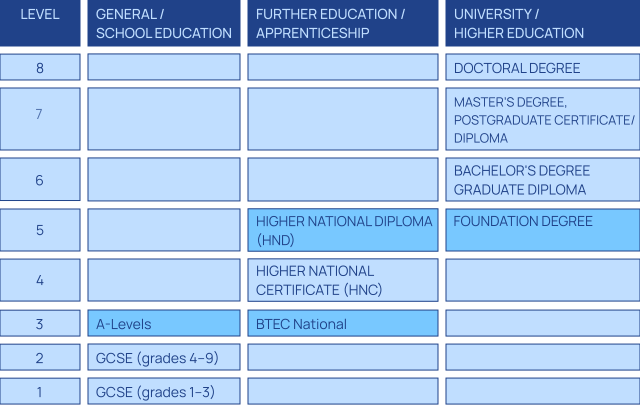
The UK education system is governed by national qualification frameworks such as the Regulated Qualifications Framework (RQF) and SCQF (Scotland).
Key study levels include:
- Doctoral Degree
- Master’s Degree
- Bachelor's Degree
UK institutions emphasise independent learning, research excellence, and academic rigour.
Frequently Asked Questions
Related Blogs
Book a Session
What are the most popular courses to study in the UK?
Some of the most popular and in-demand courses among international and Nepali students are Business, Finance, Engineering, Medicine, International Relations.
What is the cost of studying in the UK?
The cost of study varies depending on the course and institution:
- Tuition fees vary by course and institution:
- Bachelor’s programs: GBP 11,000 – 20,000 per year
- Master’s programs: GBP 12,000 – 25,000 per year
- (Medical and MBA programs may cost more)
Are scholarships available for Nepali students?
Yes. Nepali students may be eligible for Chevening Scholarships, Commonwealth Scholarships, and a range of university-specific merit-based scholarships.
How much does the IELTS cost in 2026?
Fees vary by country. In Nepal, the cost for 2026 is approximately NPR 33,000 for computer-based and NPR 36,200 for paper-based exams.
Are scholarships available for Nepali students?
Yes. Nepali students may be eligible for Chevening Scholarships, Commonwealth Scholarships, and a range of university-specific merit-based scholarships.
What is the cost of living in the UK?
- Average Monthly Cost: GBP 1,200 – 1,800
- Breakdown:
- Accommodation: GBP 700 – 1,200
- Food: GBP 200 – 350
- Transport: GBP 100 – 200
- Utilities & phone: GBP 80 – 150
- Personal expenses: GBP 150 – 300
- Annual Estimate: GBP 14,000 – 21,000
London and nearby areas have higher living costs.
How much GPA is required to study in the UK from Nepal?
- Academic requirements vary by institution:
- Bachelor’s programs: 2.5 – 3.0 GPA (or equivalent)
- Master’s programs: 2.8 – 3.0 GPA or higher
- Lower GPAs may be considered with relevant work experience or pathway programs.
How much IELTS score is required to study in the UK?
- English requirements depend on the course and university:
- Bachelor’s programs: IELTS 6.0 – 6.5
- Master’s programs: IELTS 6.5 – 7.0
Can Nepali students work while studying in the UK?
Yes. International students can work up to 20 hours per week during term time and full-time during holidays.
Can I stay in the UK after graduation?
Yes. Graduates can apply for the Graduate Route Visa, allowing them to stay and work in the UK for 2 years (or 3 years for PhD graduates).
Can dependents accompany students to the UK?
Dependants may be allowed for postgraduate research programs or government-sponsored students, subject to current UK immigration rules.
Lorem Ipsum is simply dummy text of the printing
Lorem Ipsum is simply dummy text of the printing
Book a Session

.svg)