Why study in Malaysia?
Malaysia is a growing hub for international education, offering high-quality programs at affordable costs. With English-taught programs and strong links to top universities worldwide, Malaysia is ideal for Nepali students seeking cost-effective global education.




Key Highlights
Globally Recognised Degrees
Degrees awarded in Malaysia, including transnational programs, are recognised worldwide.
International University Partnerships
Opportunity to study Australian, UK, or US degree programs through university partnerships.
Affordable Education
Lower tuition fees and cost of living compared to Western countries.
Multicultural Environment
Safe, diverse environment with a welcoming international student community.

Quick Facts

Capital
Kuala Lumpur

Currency
Malaysian Ringgit (MYR)

Intakes
February, July, May, September

Language of Instruction
English

Work Rights
Part-time work up to 20 hours per week during semester breaks

Popular Cities
Kuala Lumpur, Selangor, Penang, Johor Bahru
Application Checklist & Process
- Academic counselling and course selection
- University shortlisting and academic documents submission
- Statement of Purpose (SOP) and offer application
- Offer acceptance
- Financial documentation preparation
- Student Pass (Visa) application through EMGS
- Pre-departure briefing and travel guidance
Student Visa (Subclass 500): Key Points
- Offer letter from a Malaysian institution
- Visa approval letter (VAL) issued via Education Malaysia Global Services (EMGS)
- Proof of financial capacity
- Medical examination
- Academic and passport documents
Country map
To view the map, switch to the desktop view.
Universities
International Branch Campuses

Monash University Malaysia
University of Nottingham Malaysia
Curtin University Malaysia (Miri)
Swinburne University of Technology Sarawak
Heriot-Watt University Malaysia (Putrajaya)
University of Southampton Malaysia
University of Reading Malaysia
Malaysian campuses of leading Australian and UK universities, offering the same globally recognised degrees as the home campus at a lower cost of study and living. These campuses have large international communities, established student support, and strong links with industry.
Leading Private Universities
Taylor's University
Sunway University
UCSI University
Asia Pacific University (APU)
INTI International University
Multimedia University (MMU)
Management and Science University (MSU)
Well-established Malaysian private universities with strong academic reputations, modern facilities, and diverse international student communities. They offer a wide range of programs, flexible entry pathways, and good graduate outcomes at affordable tuition.
Education Framework in Malaysia
.svg)
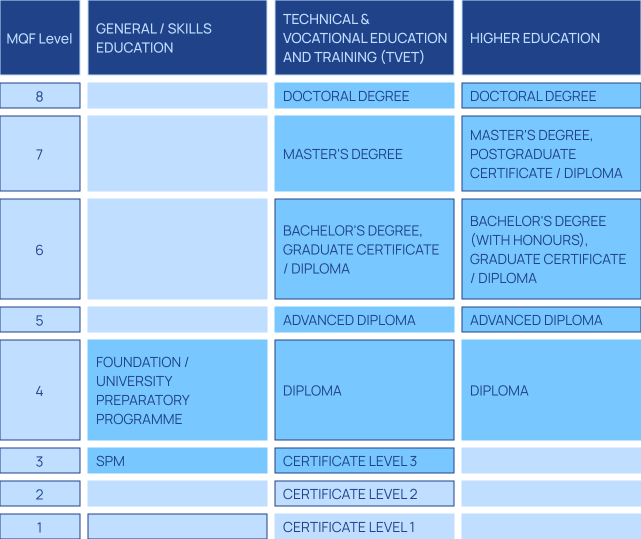
The Malaysian Qualifications Framework (MQF), with its clean 8-level structure, is very well aligned with international norms and widely recognised.
Key study levels include:
- Doctoral Degree
- Master’s Degree
- Bachelor's Degree
Malaysian institutions are known for their affordability, multilingual environment, and globally recognised qualifications.
Frequently Asked Questions
What are the most popular courses in Malaysia?
Popular and high-demand programs among international and Nepali students include Engineering, Business, IT, Hospitality, Nursing.
What is the cost of studying in Malaysia?
- Tuition fees vary by institution and program:
- Diploma programs: MYR 8,000 – 15,000 per year
- Bachelor’s programs: MYR 25,000 – 60,000 per year
- Master’s programs: MYR 30,000 – 75,000 per year
- Twinning and international degree programs are on the higher end.
Are scholarships available for Nepali students?
Yes. Malaysian universities offer merit-based scholarships, tuition discounts, and limited government-supported funding for international students.
How much GPA is required to study in Malaysia from Nepal?
- Academic requirements are generally flexible:
- Diploma & Bachelor’s: 2.3 – 3.0 GPA or equivalent
- Master’s programs: 2.5 – 3.0 GPA or higher
- Lower GPAs may be considered through pathway programs.
What is the cost of living in Malaysia?
- Average monthly living cost: MYR 1,500 – 2,500
- Breakdown:
- Accommodation: MYR 700 – 1,200
- Food: MYR 400 – 700
- Transport & utilities: MYR 200 – 400
How much IELTS score is required to study in Malaysia?
- English requirements are relatively flexible:
- Diploma & Bachelor’s: IELTS 5.5 – 6.0
- Master’s programs: IELTS 6.0 – 6.5
- Many institutions also offer English pathway programs if requirements are not met.
How much study gap is accepted for Malaysia?
Up to 3–5 years is commonly acceptable. Longer gaps may be considered if explained with work experience or training.
Can Nepali students work while studying?
- Yes, with conditions.
- Students can work part-time up to 20 hours per week
- Work is permitted during semester breaks
- Employment is limited to approved sectors
Lorem Ipsum is simply dummy text of the printing
Lorem Ipsum is simply dummy text of the printing
Book a Session