
.svg)
Why study in New Zealand?
New Zealand is known for its high-quality education system, beautiful environment, and safe living conditions, making it a top choice for international students.




Key Highlights
Globally Recognized Degrees
8 universities ranked among the world’s top 100 (Group of Eight).
Scholarship Opportunities
Prestigious awards such as the Australia Awards and university-specific scholarships.
Post-Study Work Opportunities
Post-Study Work Visa (Subclass 485) of up to 4 years.
Career Pathways
Close industry links, internships, and employment opportunities during and after study.
Strong Nepali Community
A safe, multicultural society with extensive support networks.
Strong Nepali Community
A safe, multicultural society with extensive support networks.

Quick Facts

Capital
Wellington

Currency
New Zealand Dollar (NZD)

Language of Instruction
English

Intakes
February, July

Work Rights
Up to 20 hours per week during study, full-time during scheduled breaks

Popular Cities
Auckland, Wellington, Christchurch, Hamilton, Dunedin
Application Checklist & Process
- Academic counselling and course selection
- University shortlisting and academic documents submission
- Statement of Purpose (SOP) and offer application
- Offer acceptance and Confirmation of Enrolment (CoE)
- No Objection Letter (NOC) from the Ministry of Education
- Financial documentation preparation
- Visa application and interview preparation
- Pre-departure briefing and travel guidance
Student Visa (Subclass 500): Key Points
- Confirmation of Enrolment (CoE) from a New Zealand institution
- Genuine student intent
- Proof of financial capacity
- English language proficiency (IELTS / PTE or equivalent)
- Acceptable medical and police certificates
- Academic and character requirements
Country map
To view the map, switch to the desktop view.
Education Framework in New Zealand
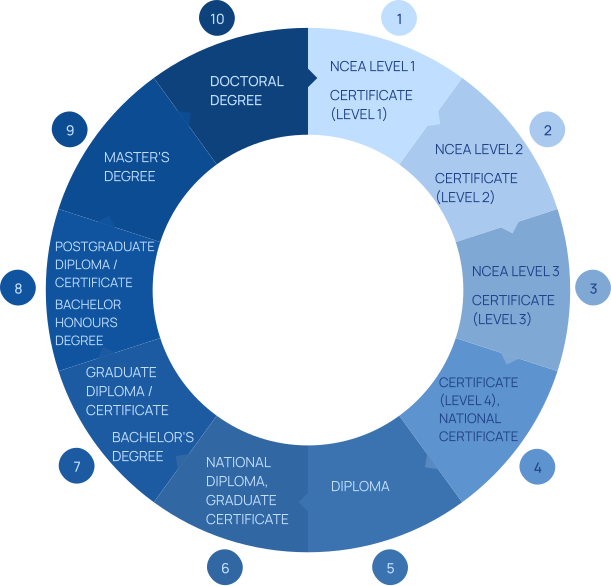
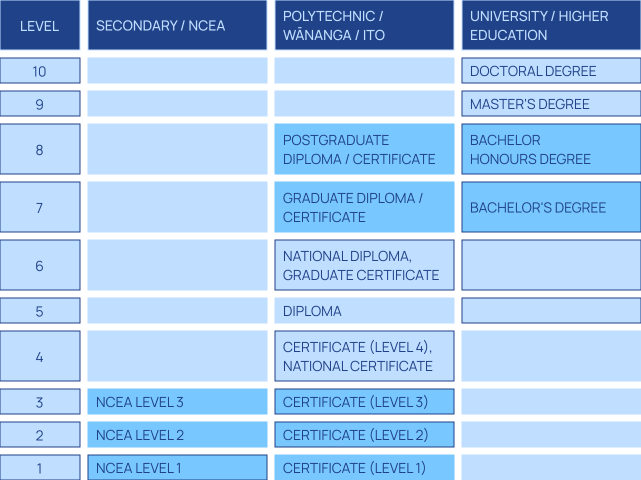
New Zealand’s education system is governed by the New Zealand Qualifications Framework (NZQF), ensuring consistency and quality across all institutions. The NZQCF is divided into 10 levels. Each level describes what a graduate is expected to know, understand and be able to do.
Key study levels include:
- Doctoral Degree
- Master’s Degree
- Bachelor's Degree
New Zealand universities offer a safe, student-friendly environment and are recognised globally for quality teaching
Universities
Ivy League Universities

University of Auckland
New Zealand’s largest and highest-ranked university with broad offerings across disciplines.
University of Otago
Oldest university in New Zealand, strong in sciences, health, business, and humanities.
Victoria University of Wellington
Excellent for law, public policy, arts, and data science.
University of Canterbury
Known for engineering, science, business & arts.
Massey University
Flexible programs including distance learning; strong in agriculture, business, education.
Auckland University of Technology (AUT)
Applied, career-focused degrees, strong in IT, business, design.
University of Waikato
Strengths include computing, business, education, environmental science.
Lincoln University
Specialist in agriculture, environment, life sciences.
These are the eight public research universities in New Zealand, all of which offer a wide range of programs and degrees.
Frequently Asked Questions
What are the most popular courses to study in New Zealand?
Some of the most popular and in-demand courses among international and Nepali students are Agriculture & Environmental Studies, Engineering, Health Sciences & Nursing
What is the cost of studying in New Zealand?
- The cost of study depends on the course and institution.
- Diploma & Bachelor’s programs: NZD 20,000 – 32,000 per year
- Master’s programs: NZD 22,000 – 40,000 per year
Are scholarships available for Nepali students?
Yes. Both government-funded and university-specific scholarships are available based on academic merit and eligibility.
What is the cost of living in New Zealand?
- Average Monthly Cost: NZD 1,800 – 2,500
- Breakdown:
- Accommodation: NZD 800 – 1,400
- Food: NZD 250 – 450
- Transport: NZD 100 – 180
- Utilities & phone: NZD 100 – 180
- Personal expenses: NZD 150 – 300
- Annual Estimate: NZD 21,000 – 30,000
How much IELTS score is required to study in New Zealand?
- English language requirements depend on the level of study:
- Diploma & Bachelor’s: IELTS 6.0 – 6.5
- Master’s programs: IELTS 6.5 (some programs require 7.0)
- Nursing, Teaching & Health courses: IELTS 7.0 or higher
Is New Zealand safe for international students?
Yes. New Zealand consistently ranks among the safest countries globally, with strong legal protections and student welfare systems.
Can Nepali students work while studying in New Zealand?
Yes. International students can work up to 20 hours per week during study periods and full-time during scheduled breaks.
Can I stay in New Zealand after graduation?
Eligible graduates can apply for a Post-Study Work Visa, allowing them to gain valuable work experience for up to 3 years, depending on their qualification.
Lorem Ipsum is simply dummy text of the printing
Lorem Ipsum is simply dummy text of the printing
Book a Session