

Why study in South Korea
South Korea is emerging as a top destination for international students seeking high-quality technical and business education at relatively affordable tuition. English-taught programs are widely available.




Key Highlights
Globally Recognised Universities
Top universities are ranked in global lists, especially in engineering, IT, and business.
Scholarships
Programs like KGSP (Korean Government Scholarship Program) and university scholarships for international students.
Career Opportunities
Strong industry links, especially in technology, manufacturing, and business sectors.
Post-Study Work Opportunities
Graduates can work in Korea under the D-10 Job Seeker Visa, allowing up to 2 years to gain relevant work experience.
Quick Facts

Capital
Seoul

Currency
South Korean Won (KRW)

Language of Instruction
English / Korean

Intakes
March, September

Work Rights
Part-time allowed up to 20 hours/week

Popular Cities
Seoul, Busan, Daejeon
Application Checklist & Process
- Academic counselling and course selection
- Institution shortlisting and document submission
- Statement of Purpose (SOP) and application submission
- Offer acceptance and Certificate of Admission
- Financial documentation preparation
- Visa application (D-2 Student Visa) and interview preparation
- Pre-departure briefing and travel guidance
- Pre-departure briefing and travel guidance
Student Visa (Subclass 500): Key Points
- Certificate of Admission from a recognized Korean university
- Proof of financial capacity (tuition + living costs)
- Academic records and Statement of Purpose
- Medical check-up may be required
- Korean language or English proficiency depending on the program
Country map
To view the map, switch to the desktop view.
Education Framework in New Zealand
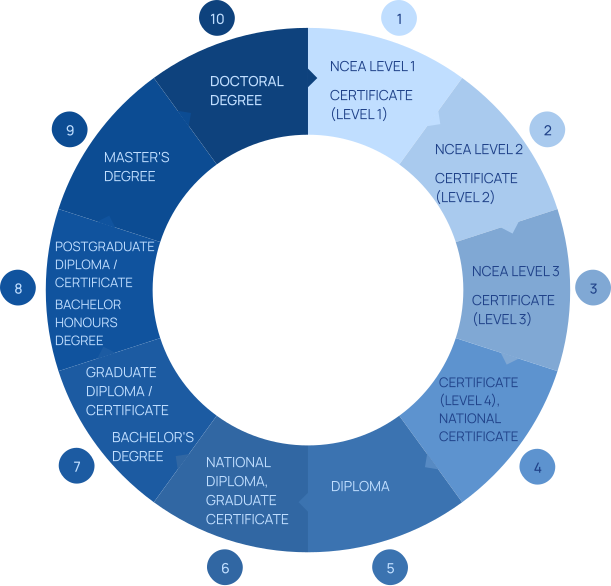
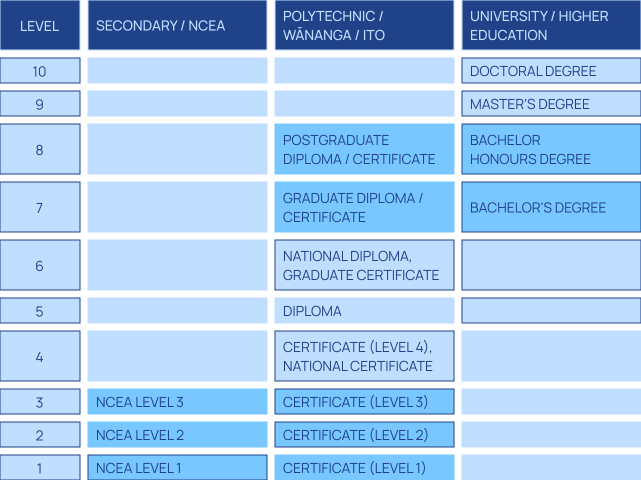
New Zealand’s education system is governed by the New Zealand Qualifications Framework (NZQF), ensuring consistency and quality across all institutions. The NZQCF is divided into 10 levels. Each level describes what a graduate is expected to know, understand and be able to do.
Key study levels include:
- Bachelor’s Degree
- Master’s Degree
- Doctoral (PhD) Programs
Mauritius’ higher education sector is regulated by the Higher Education Commission (HEC), ensuring academic quality and international standards.
Universities
Recommended Universities

Seoul National University (SNU)
Korea’s top-ranked university
Korea University
Strong in business, law, social sciences
Yonsei University
Highly international, many English programs
KAIST
Leading science & engineering university
POSTECH
Research-focused, STEM excellence
Hanyang University
Engineering, technology, strong industry links
South Korea offers high-quality education, strong global rankings, and generous scholarships for international students, especially in STEM and business.
Frequently Asked Questions
What are the most popular courses in South Korea?
- Some of the most popular programs among international and Nepali students include Engineering, IT, Business, Korean Language.
What is the cost of studying in South Korea?
- Tuition fees depend on the university and program:
- Undergraduate programs: KRW 4,000,000 – 8,000,000 per semester
- Master’s programs: KRW 4,500,000 – 9,000,000 per semester
- Scholarship opportunities can cover up to 70–100% tuition
What scholarships are available for Nepali students?
- Korean Government Scholarship Program (KGSP)
- University-specific scholarships for academic excellence
- Partial tuition scholarships for international students
What is the cost of living in South Korea?
- Average Monthly Cost: KRW 900,000 – 1,500,000
- Breakdown:
- Accommodation: KRW 300,000 – 700,000
- Food & groceries: KRW 200,000 – 400,000
- Transport: KRW 50,000 – 100,000
- Utilities & phone: KRW 50,000 – 100,000
- Personal expenses: KRW 100,000 – 200,000
- Annual Estimate: KRW 10,800,000 – 18,000,000
Seoul is the most expensive city; smaller cities are more affordable.
How much GPA is required to study in South Korea from Nepal?
- Academic requirements vary by institution:
- Bachelor’s programs: 2.5 – 3.0 GPA (or equivalent)
- Master’s programs: 2.8 – 3.2 GPA or higher
- Foundation or pathway programs may be available for students with lower GPAs
- Undergraduate programs: 2.5 – 3.0 GPA (or equivalent)
- Master’s programs: 2.8 – 3.2 GPA or higher
How much IELTS / Korean language score is required?
- English-taught programs: IELTS 6.0 – 6.5 for undergraduates, 6.5+ for master’s programs
- Korean-taught programs: TOPIK Level 3–4 depending on university requirements
Can Nepali students work while studying?
- Yes. International students can work up to 20 hours per week during study and full-time during holidays, with university permission.
Can I stay in South Korea after graduation?
Graduates may apply for D-10 Job Seeker Visa, allowing up to 2 years to seek employment in Korea.
Lorem Ipsum is simply dummy text of the printing
Lorem Ipsum is simply dummy text of the printing
Book a Session