

Why study in France
France is one of Europe’s most prestigious study destinations, known for its high academic standards, globally ranked universities, and affordable public education.




Key Highlights
Globally Respected Education System
Home to internationally ranked universities and elite institutions.
Wide Range of English-Taught Programs
Especially strong at the master’s level in business, engineering, and sciences.
Post-Study Work Opportunities
Stay back options available after graduation.
Rich Cultural & European Exposure
Study in a country known for innovation, history, and lifestyle quality.

Quick Facts

Capital
Paris

Currency
Euro (€)

Language of Instruction
French & English

Intakes
September (main), January (limited)

Work Rights
Up to 964 hours per year (approx. 20 hours/week)

Popular Cities
Paris, Lyon, Toulouse, Nantes, Lille, Bordeaux
Application Checklist & Process
- Academic counselling and course selection
- University/institution shortlisting
- SOP and application submission
- Offer letter issuance
- Campus France registration and interview
- Tuition fee payment
- Student visa application
- Pre-departure briefing and travel guidance
Student Visa (Subclass 500): Key Points
- Offer letter from a recognised French institution
- Campus France approval
- Proof of financial capacity
- Proof of accommodation
- Health insurance coverage
- Academic and character documentation
Country map
To view the map, switch to the desktop view.
Education Framework in New Zealand
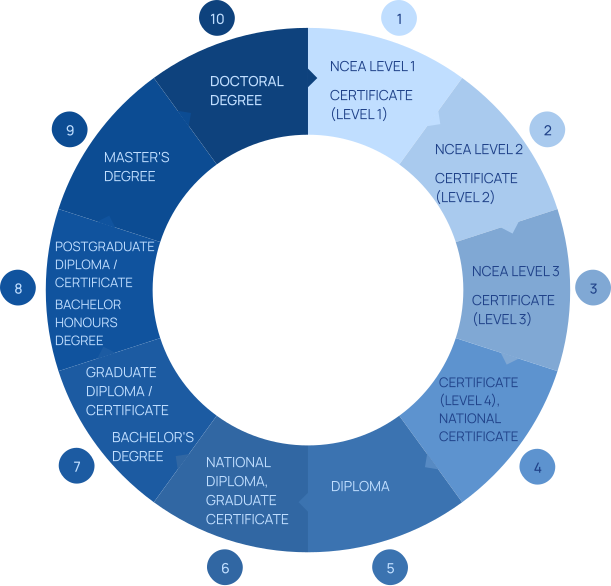
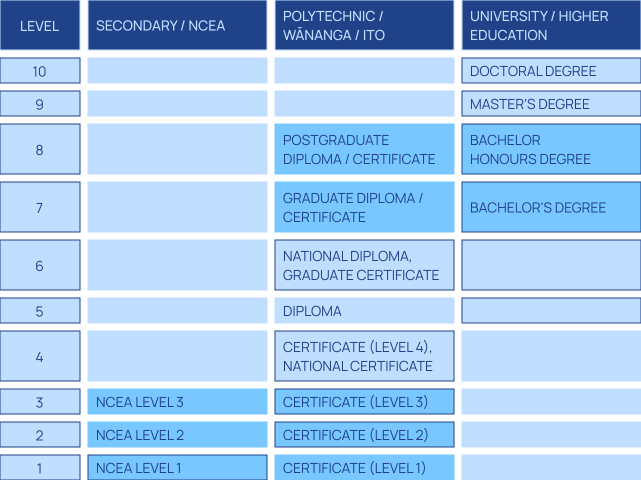
New Zealand’s education system is governed by the New Zealand Qualifications Framework (NZQF), ensuring consistency and quality across all institutions. The NZQCF is divided into 10 levels. Each level describes what a graduate is expected to know, understand and be able to do.
Key study levels include:
- Bachelor’s Degree
- Master’s Degree
- Doctoral (PhD) Programs
Dutch institutions emphasise independent thinking, group work, and real-world problem solving.
Universities
Ivy League Universities

University of Auckland
New Zealand’s largest and highest-ranked university with broad offerings across disciplines.
University of Otago
Oldest university in New Zealand, strong in sciences, health, business, and humanities.
Victoria University of Wellington
Excellent for law, public policy, arts, and data science.
University of Canterbury
Known for engineering, science, business & arts.
Massey University
Flexible programs including distance learning; strong in agriculture, business, education.
Auckland University of Technology (AUT)
Applied, career-focused degrees, strong in IT, business, design.
University of Waikato
Strengths include computing, business, education, environmental science.
Lincoln University
Specialist in agriculture, environment, life sciences.
These are the eight public research universities in New Zealand, all of which offer a wide range of programs and degrees.
Frequently Asked Questions
What are the most popular courses in France?
Popular programs among international and Nepali students include Business, Information Technology, Engineering, Hospitality, and Fashion, Design & Arts
What is the cost of studying in France?
- Public universities are highly affordable:
- Bachelor’s (public): approx. €2,770 per year
- Master’s (public): approx. €3,770 per year
- Private institutions may charge €8,000 – 20,000 per year, depending on the program.
Are scholarships available for Nepali students?
- Yes. Popular options include:
- Eiffel Excellence Scholarship
- University-specific merit scholarships
- Regional and institutional grants
What is the cost of living in France?
- Average Monthly Cost: €900 – 1,300
- Breakdown:
- Accommodation: €400 – 700
- Food & groceries: €200 – 300
- Transport: €40 – 80
- Utilities & phone: €80 – 120
- Personal expenses: €120 – 200
- Annual Estimate: €11,000 – 15,000
(Paris is more expensive than other cities.)
How much GPA is required to study in France from Nepal?
- Academic requirements vary by institution:
- Bachelor’s programs: 2.5 – 3.0 GPA (or equivalent)
- Master’s programs: 2.8 – 3.2 GPA or higher
- Requirements vary by institution and program competitiveness.
How much IELTS score is required?
- For English-taught programs:
- Bachelor’s: IELTS 6.0 – 6.5
- Master’s: IELTS 6.5
- French-taught programs require French proficiency (DELF/DALF or equivalent)
How much study gap is accepted for France?
- Study gaps are accepted if academically and professionally justified:
- 2–3 years: Generally acceptable
- Longer gaps require strong documentation and relevance
Can Nepali students work while studying?
Yes. International students can work up to 20 hours per week during study periods.
Can I stay in France after graduation?
- Yes. Graduates can apply for:
- Temporary Residence Permit (APS) for job search
- Work visa upon securing relevant employment
Lorem Ipsum is simply dummy text of the printing
Lorem Ipsum is simply dummy text of the printing
Book a Session