
.svg)
Why study in Canada?
Canada is one of the most popular study destinations for international students, known for its high-quality education system, affordable tuition compared to other major destinations, and strong pathways to post-study work and permanent residence.




Key Highlights
Globally Recognised Degrees
Universities consistently ranked among the world’s top institutions.
Affordable Education Options
Compared to other English-speaking destinations, Canada offers high-quality education at relatively affordable tuition fees.
Post-Study Work Opportunities
Eligible graduates can apply for the Post-Graduation Work Permit (PGWP) for up to 3 years.
Strong PR Pathways
Clear immigration pathways through Express Entry, Provincial Nominee Programs (PNPs), and Canadian Experience Class (CEC).
Safe & Multicultural Society
Canada is consistently ranked among the safest countries globally and is known for its inclusive, multicultural communities.

Quick Facts

Capital
Ottawa

Currency
Canadian Dollar (CAD)

Intakes
January, May (limited), September

Language of Instruction
English / French (depending on province)

Work Rights
Up to 20 hours per week during study; full-time during breaks

Popular Cities
Toronto, Vancouver, Calgary, Ottawa
Application Checklist & Process
- Academic counselling and course selection
- University shortlisting and academic documents submission
- Statement of Purpose (SOP) and offer application
- Offer acceptance and Letter of Acceptance (LOA)
- No Objection Letter (NOC) from the Ministry of Education
- Financial documentation preparation
- Biometrics and study permit application
- Pre-departure briefing and travel guidance
Education Framework in Canada
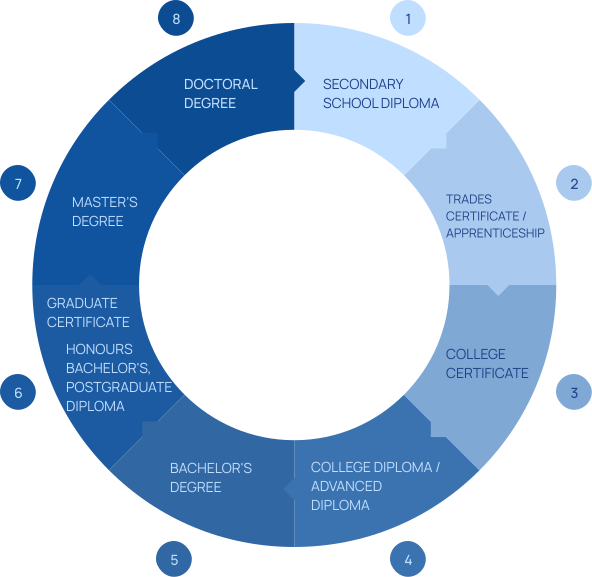
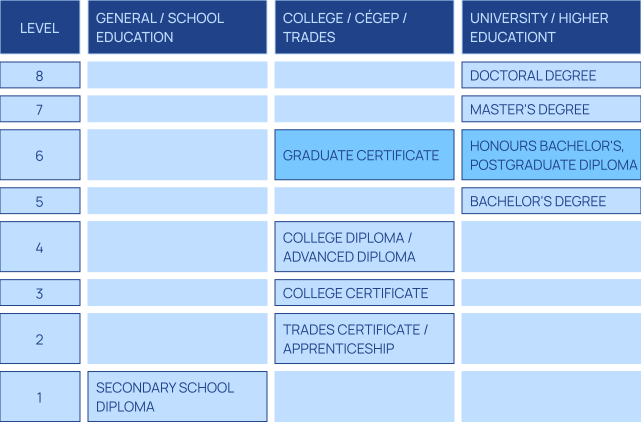
Canada has no single national framework. The education system is regulated at the provincial level, such as with the OSSD (Ontario) and CÉGEP (Quebec), ensuring high academic standards across institutions.
Key study levels include:
- Doctoral Degree
- Master’s Degree
- Bachelor's Degree
Canadian institutions are known for applied learning, co-op programs, and industry-aligned education.
Student Visa (Subclass 500): Key Points
- Letter of Acceptance (LOA) from a Designated Learning Institution (DLI)
- Proof of financial capacity (tuition + living costs)
- Statement of Purpose / Study Plan
- Medical examination and biometrics
- English language proficiency (IELTS / PTE or equivalent)
Country map
To view the map, switch to the desktop view.
Universities
U15 Group of Canadian Research Universities

University of Alberta
University of British Columbia
University of Calgary
Dalhousie University
Université Laval
University of Manitoba
McGill University
McMaster University
Université de Montréal
University of Ottawa
Queen’s University
University of Saskatchewan
University of Toronto
University of Waterloo
Western University
Canada’s leading research-intensive universities, recognised for global rankings, academic excellence, innovation, and strong graduate outcomes across a wide range of disciplines.
Polytechnics Canada
Algonquin College
British Columbia Institute of Technology
Conestoga College
Fanshawe College
George Brown College
Humber Polytechnic
Kwantlen Polytechnic University
Northern Alberta Institute of Technology
Red River College Polytechnic
Southern Alberta Institute of Technology
Saskatchewan Polytechnic
Seneca Polytechnic
Sheridan College
Publicly funded institutions focused on applied education, industry partnerships, and hands-on learning. Known for strong employability outcomes, co-op programs, and practical, career-ready qualifications.
Comprehensive & Public Universities
Simon Fraser University
York University
University of Guelph
Carleton University
University of Victoria
University of Windsor
Memorial University of Newfoundland
Toronto Metropolitan University (TMU)
Concordia University
Well-rounded public universities offering strong research activity alongside a broad range of undergraduate and postgraduate programs, particularly in urban and research-driven environments
Primarily Undergraduate Universities
Mount Allison University
Acadia University
Bishop’s University
Brandon University
Cape Breton University
University of Lethbridge
Laurentian University
Nipissing University
St. Francis Xavier University
St. Thomas University
Trent University
University of Prince Edward Island
Teaching-focused universities known for smaller class sizes, personalised learning, and a strong undergraduate experience, with limited postgraduate and doctoral programs.
Regional & Provincial Universities
Vancouver Island University
Thompson Rivers University
University of Northern British Columbia
Royal Roads University
MacEwan University
Mount Royal University
University of Regina
Athabasca University
University of Moncton
University of Sudbury
Public universities that play a key role in regional development, offering affordable education, strong student support, and attractive pathways for immigration and post-study settlement.
Frequently Asked Questions
What are the most popular courses to study in Canada?
Popular and high-demand programs among international and Nepali students include IT, Data Analytics, Business, Finance, Engineering.
What is the cost of studying in Canada?
- Tuition fees depend on the institution and program:
- Diploma & Advanced Diploma: CAD 15,000 – 22,000 per year
- Bachelor’s programs: CAD 18,000 – 35,000 per year
- Master’s programs: CAD 20,000 – 40,000 per year
Are scholarships available for Nepali students?
Yes. Canadian institutions offer merit-based scholarships, entrance awards, and limited government-funded options at postgraduate level.
What is the cost of living in Canada?
- Average Monthly Cost: CAD 1,500 – 2,400
- Breakdown:
- Accommodation: CAD 700 – 1,400
- Food: CAD 300 – 500
- Transport: CAD 100 – 180
- Utilities & phone: CAD 100 – 180
- Personal expenses: CAD 150 – 300
- Annual Estimate: CAD 18,000 – 28,000
- Living costs vary by province and city.
How much GPA is required to study in Canada from Nepal?
- Academic requirements vary by institution:
- Diploma & Bachelor’s: 2.5 – 3.0 GPA (or equivalent)
- Master’s programs: 2.8 – 3.2 GPA or higher
- Lower GPAs may be considered with relevant work experience or pathway programs.
How much IELTS score is required to study in Canada?
- English language requirements depend on the program:
- Diploma & Bachelor’s: IELTS 6.0 (no band less than 5.5)
- Master’s programs: IELTS 6.5 (some require 7.0)
Can Nepali students work while studying in Canada?
Yes. International students can work up to 20 hours per week during academic sessions and full-time during scheduled breaks.
Can I stay in Canada after graduation?
Yes. Eligible graduates can apply for a Post-Graduation Work Permit (PGWP) of up to 3 years, which can support pathways to Permanent Residence (PR).
Lorem Ipsum is simply dummy text of the printing
Lorem Ipsum is simply dummy text of the printing
Book a Session