

Why study in Germany
Germany is one of the most attractive study destinations in Europe, renowned for its high-quality education, strong engineering and technical focus, and minimal or no tuition fees at public universities.




Key Highlights
Globally Recognised Degrees
German universities consistently rank among the world’s best, particularly in engineering, technology, and applied sciences.
Low or No Tuition Fees
Most public universities charge no tuition fees for undergraduate and many postgraduate programs (semester contributions apply).
Post-Study Work Opportunities
Graduates can stay for up to 18 months after graduation to find employment related to their field of study.
Strong Economy & Career Prospects
Home to global companies such as BMW, Siemens, Bosch, SAP, and a strong startup ecosystem.

Quick Facts

Capital
Berlin

Currency
Euro (EUR)

Language of Instruction
German / English

Intakes
March/April, September/October

Work Rights
120 full days or 240 half days per year

Popular Cities
Berlin, Munich, Hamburg, Frankfurt, Stuttgart, Cologne
Application Checklist & Process
- Academic counselling and course selection
- University shortlisting and academic documents submission
- Language preparation (IELTS / German – if required)
- Offer application via Uni-Assist or direct university portals
- Offer acceptance
- Blocked account and financial documentation preparation
- Student visa application and interview preparation
Student Visa (Subclass 500): Key Points
- Admission letter from a recognised German institution
- Proof of financial capacity
- Valid passport and academic records
- Health insurance coverage
- Language proficiency (English or German, depending on program)
Country map
To view the map, switch to the desktop view.
Education Framework in New Zealand
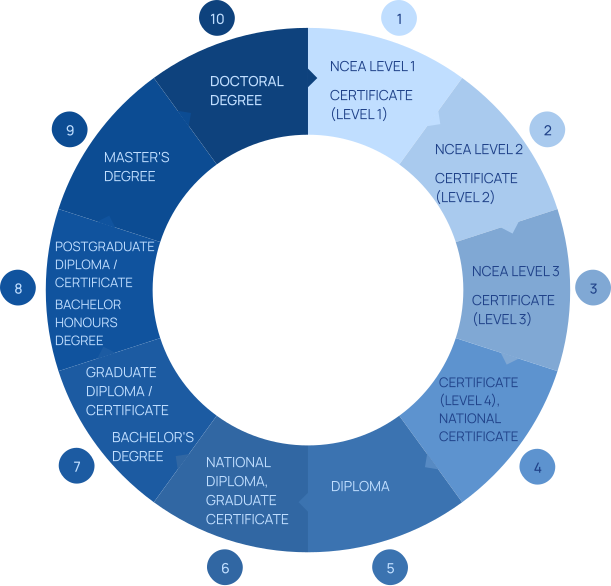
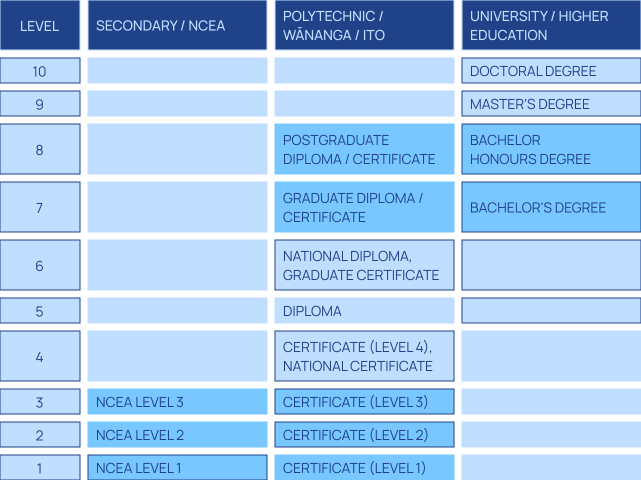
New Zealand’s education system is governed by the New Zealand Qualifications Framework (NZQF), ensuring consistency and quality across all institutions. The NZQCF is divided into 10 levels. Each level describes what a graduate is expected to know, understand and be able to do.
Key study levels include:
- Bachelor’s Degree
- Master’s Degree
- Doctoral (PhD) Programs
Dutch institutions emphasise independent thinking, group work, and real-world problem solving.
Universities
Recommended Universities

Technical University of Munich (TUM)
LMU Munich
RWTH Aachen University
Heidelberg University
Humboldt University of Berlin
Free University of Berlin
University of Freiburg
Germany is known for low or no tuition fees, strong public universities, and excellent engineering and applied sciences education.
Frequently Asked Questions
What are the most popular courses in Germany?
Popular programs among international and Nepali students include Engineering, IT, Computer Science, Renewable Energy & Environmental Engineering.
What is the cost of studying in Germany?
- Tuition fees depend on the institution and program:
- Public universities: No tuition fees for most programs
- Semester contribution: EUR 250 – 350 per semester
- Private universities: EUR 10,000 – 20,000 per year
Are scholarships available for Nepali students?
- Yes. Scholarships include:
- DAAD Scholarships
- University-specific merit-based funding
- Research and PhD funding opportunities
What is the cost of living in Germany?
- Average Monthly Cost: EUR 850 – 1,200
- Breakdown:
- Accommodation: EUR 300 – 600
- Food & groceries: EUR 150 – 250
- Transport: EUR 60 – 120
- Health insurance: EUR 100 – 120
- Personal expenses: EUR 100 – 200
- Annual Estimate: EUR 10,200 – 14,400
How much GPA is required to study in Germany from Nepal?
- Academic requirements vary by institution:
- Bachelor’s programs: 2.5 – 3.0 GPA (or equivalent)
- Master’s programs: 2.7 – 3.2 GPA or higher
- Some programs may have stricter entry requirements
How much IELTS or German language score is required?
- English-taught programs: IELTS 6.0 – 6.5 (Master’s often 6.5+)
- German-taught programs: TestDaF / DSH or Goethe certificates (B1–C1 level)
Can Nepali students work while studying?
Yes. International students can work 120 full days or 240 half days per year without a special permit.
Can I stay in Germany after graduation?
Yes. Graduates can stay in Germany for up to 18 months to find a job related to their qualification and later apply for a work permit or EU Blue Card.
Lorem Ipsum is simply dummy text of the printing
Lorem Ipsum is simply dummy text of the printing
Book a Session