
.svg)
If you worked hard through your +2 or Bachelor's, but your GPA didn't turn out the way you hoped, you might be wondering whether New Zealand is even an option for further study.
Study in New Zealand With a Low GPA
Can I Study in New Zealand With a Low GPA From Nepal?
Choosing the right pathway to study in New Zealand
The honest answer is yes, in many cases you can. A low GPA makes the path narrower, not closed. What matters is choosing the right route and presenting your profile well.
First, what counts as a "low" GPA?
There is no single number. New Zealand universities and colleges set their own entry rules, and these vary by course. A GPA that is perfectly fine for a diploma or pathway programme may fall short of a direct Master's entry in a competitive subject such as engineering, health sciences or IT. So "low" really means "lower than what your first-choice course asks for."
The better question is not "Is my GPA low?" but "Why did I not qualify?" It might be your +2 result, your Bachelor's marks, your English score, or the subjects you studied. Each cause has a different fix, and some of them are not about GPA at all.
The good news is that New Zealand offers more than one doorway into higher education.
Your realistic options with a lower GPA
1. Foundation or pathway programmes after +2
If you have finished +2 and your grades are below the direct-entry level for a Bachelor's degree, a foundation or pathway programme is often the smartest route. These programmes are designed to prepare international students academically and for life in New Zealand. Successful completion can lead into the first or second year of a degree, depending on the programme and the partner institution.
Pathway colleges attached to universities, such as UC International College and University of Waikato College, exist for exactly this kind of student. Entry requirements and progression rules differ for each, so always confirm the current criteria before applying.
2. Diploma programmes that lead into a degree
Some institutions offer Level 5 or Level 6 diplomas that can later be credited toward a Bachelor's degree. If your academic record is modest, starting with a diploma lets you build a stronger New Zealand transcript first.
3. Pre-Master's or graduate preparation programmes
If you hold a Bachelor's degree with a lower GPA, a Pre-Master's or graduate pathway can bridge the gap to postgraduate study. This is a common route for students whose undergraduate marks don't meet direct Master's entry.
4. Institutes of Technology and polytechnics, and private training establishments
These often have more flexible entry requirements and strongly practical, job-focused courses in areas like business, hospitality, trades, IT and health support. You can still progress to higher qualifications later.
5. Direct entry to a degree
Direct entry is still possible for some courses, especially where a strong English score, relevant work experience or a good personal statement offsets the GPA. It is the hardest route with a low GPA, so treat it as one option, not the only one.
Your pathway options
Two strong pathway options in New Zealand are UC International College (UCIC), which leads into the University of Canterbury, and University of Waikato College (UWC), which leads into the University of Waikato. Entry requirements below are for students from Nepal. Check each college's official page before you apply, because requirements and intakes change.
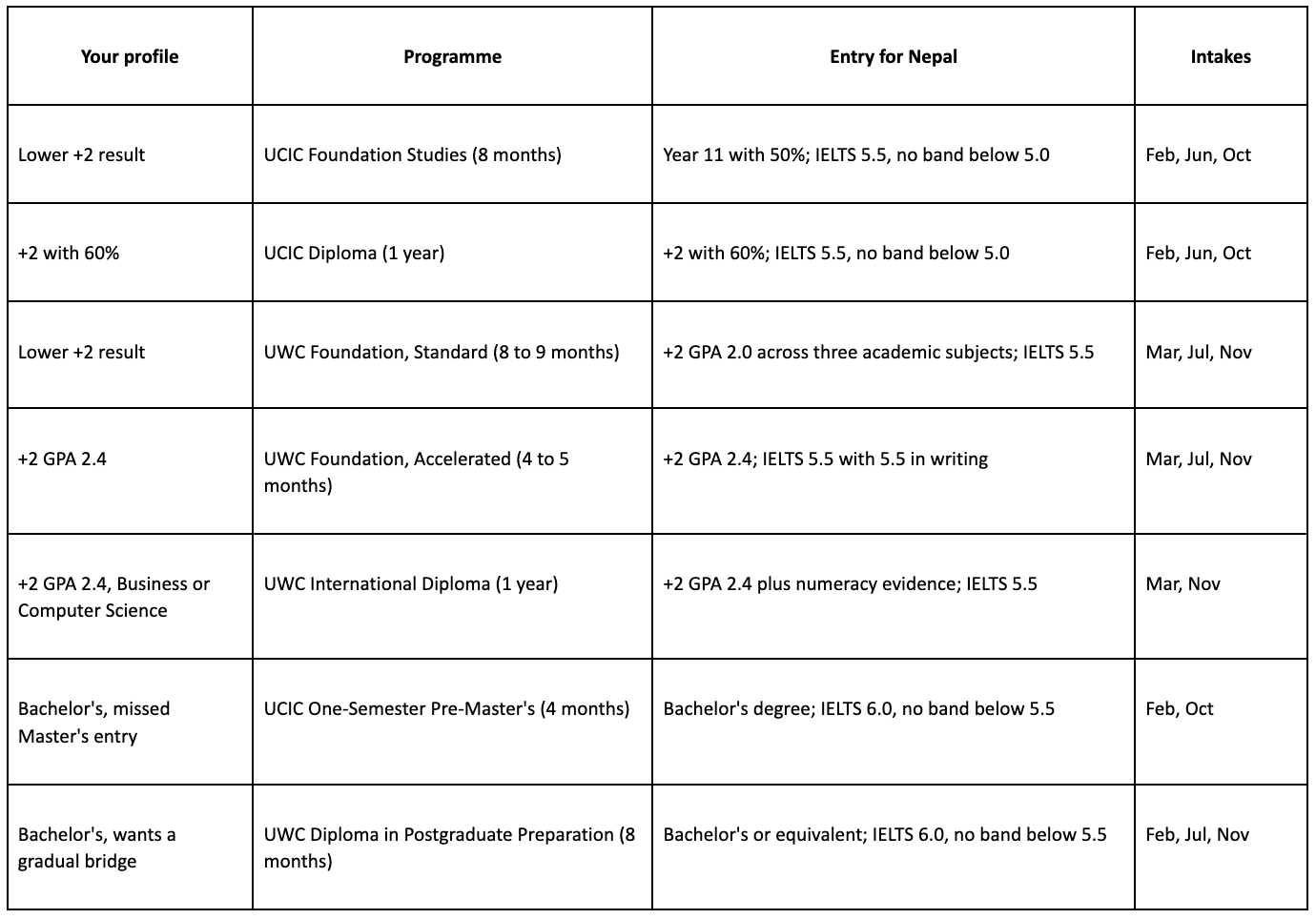
The Diploma routes have extra subject requirements for Science and Engineering. A counsellor can match these to your marks and subjects.
Who should not take a pathway?
A pathway is not right for everyone. It may not suit you if:
- you already meet direct entry and can apply straight to the degree
- you cannot show a clear reason for choosing the course and the provider
- the main obstacle is something a pathway does not fix, such as funding or a documents problem
What else do admissions teams look at?
Your GPA is one part of your application. Providers and Immigration New Zealand (INZ) look at the whole picture.
English proficiency. A solid IELTS or equivalent score can reassure a university that you will cope with the academic workload. Many students with a low GPA improve their chances by retaking the test and raising their score.
Subject match. Applying for a course related to your previous studies or work experience makes your application more believable.
Statement of Purpose (SOP). This is your chance to explain your story: why your results were what they were, what you have learned since, and why this course fits your goals. Be honest and specific. Avoid copied templates.
Work experience or certifications. Relevant jobs, internships, short courses and training show commitment beyond your marks.
Recommendation letters. Strong references from teachers or employers can carry real weight.
Study gaps. If you have a gap, be ready to explain it clearly with documents. Unexplained gaps worry both universities and visa officers.
Common mistakes to avoid
Applying only to the most competitive courses. Apply across a realistic mix of options.
Hiding or changing your marks. Never submit false or altered documents. This can lead to refusal and a long-term ban from applying.
Choosing a course just because admission is easy. Make sure it connects to a career goal and a possible progression route.
Weak or generic SOPs. Your story is your biggest advantage when your numbers aren't perfect.
Leaving funds and documents to the last minute. Plan your financial evidence early and keep the source of funds clear.
Relying on rumours. Entry rules change by intake and institution. Get current information from a qualified adviser.
So, can you study in New Zealand with a low GPA?
Yes. A lower GPA may mean you start with a foundation, diploma or Pre-Master's programme instead of going straight into a degree, but those routes can still lead you to the same qualification and a New Zealand graduate outcome. The key is to be realistic, choose the right pathway, and build a strong, honest application.
Talk to NEC
At Nepal Education Consultancy, our counsellors help Nepali students compare New Zealand pathways, prepare strong applications and plan their visa documents step by step. If you are unsure whether your GPA is enough, drop by NEC and we will look at your profile and suggest options that fit.